US Navy Data and Artificial Intelligence Weaponization Strategy, 14 July 2026
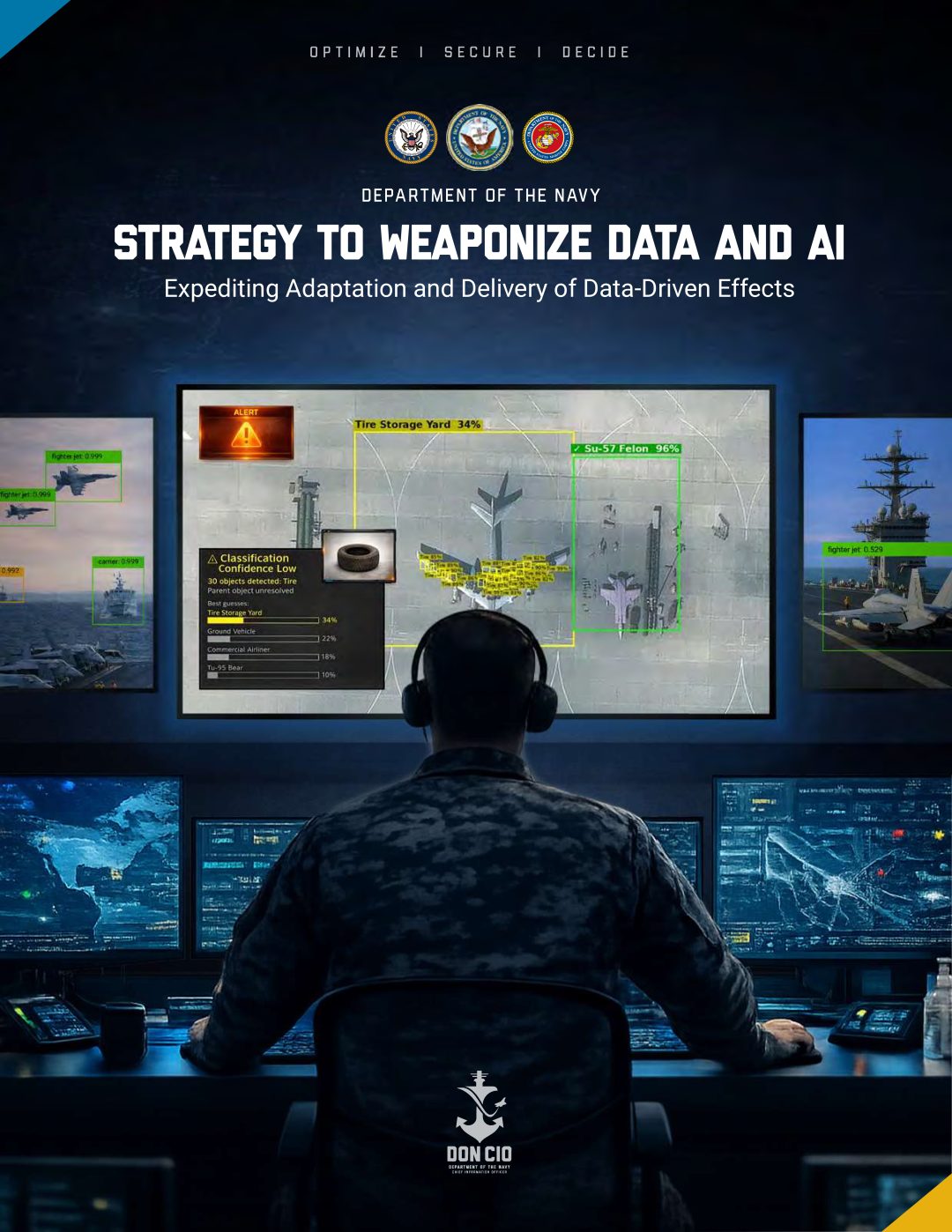
The US Department of the Navy released its Data and Artificial Intelligence Weaponization Strategy on 14 July 2026. The document defines a bits-to-effects cycle, six program objectives, and fiscal-year checkpoints through FY2029.
The US Department of the Navy released the Data and Artificial Intelligence Weaponization Strategy on 14 July 2026. The paper sets a bits-to-effects cycle that links data collection, processing and analysis, capability generation, and operational employment. It treats data and artificial intelligence as means to shape maritime advantage rather than as information-support tools only. A 16 September 2026 commentary presents the document as Navy-level implementation of the US Department of War AI-first objective and as a plan for data-driven continuous learning, adaptation, and capability iteration.
Bits-to-effects cycle and MTTE
The strategy uses the bits-to-effects cycle as the Department of the Navy framework for integrating data and artificial intelligence. Mean time to effect (MTTE) measures the interval from data generation to a data-driven operational effect.
The cycle has five sequential stages. Data collection automatically gathers data from sensors, weapons, and platforms. Data transport moves data to processing environments and is required to function under constrained communications. Security and access apply progressive automated security marking and access control. Development and analysis use AI and machine learning tools, computing infrastructure, and specialists to turn data into usable capability. Test and employment deliver data-driven operational effects to operators.
Five classes of data-driven effect are listed: optimized combat-system performance; improved tactics, techniques, and procedures; enhanced decision support; optimized training; and generation of new operational capabilities.
Six development objectives
The strategy names six objectives.
1. Accelerate operational artificial intelligence by screening promising projects and scaling successful pilots. 2. Raise data readiness by standardizing, simplifying, and scaling data management and by promoting mission data sharing. 3. Improve data and AI infrastructure by building modular environments for analysis and AI functions. 4. Streamline data and AI governance by adjusting organization and process and by delegating risk decisions. 5. Build a skilled data and AI workforce for changing wartime conditions. 6. Strengthen collaboration with industry, academia, federal agencies, and allies to speed delivery of technical solutions.
Fiscal-year checkpoints
The strategy converts the six objectives into dated tasks.
In the third quarter of fiscal year 2026, a monthly review is to remove non-legal barriers that constrain data sharing, contracting, and fielding.
In the first quarter of fiscal year 2027, the Department of the Navy is to complete an AI product and activity authority registry for coordinated management and scaled adoption; start quarterly hackathons that produce prototypes against operational problems; field controlled unclassified and secret-level AI sandboxes so business and operational data can support development and test on real mission data; and deploy large-model and agent capabilities to forward forces for denied, degraded, intermittent, and latent environments.
In the second quarter of fiscal year 2027, it is to automate determinations of data sensitivity and classification, prepare top-secret environment infrastructure, and complete a digital-twin simulation acceptance-test environment.
By the end of fiscal year 2027, it is to finish consolidation of duplicate data and AI capabilities.
By the end of fiscal year 2029, it is to double the number of qualified data engineers, data scientists, and AI and machine learning engineers.
Risks noted in the commentary
The analysis states that faster military AI adoption still faces data-security, technical-reliability, and external-dependency risks. Cross-platform and cross-classification data flow can raise AI performance and can also increase exposure to data leakage, network attack, and supply-chain incidents. Rapid fielding can outpace test, verification, and reliability assessment, leaving model error and decision risk in complex combat conditions. Use of commercial AI and outside partners can create dependence on external technology and supply chains. The authors state that military AI competition is moving from single-algorithm advances toward combined competition over data holdings, organization, and conversion of data into capability.
The commentary is attributed to Kehui Think Tank authors Qi Yuantao, Sun Mingyue, Zhang Xu, and Wang Xinyi.